
Blog
What a USPAP-Compliant Piano Appraisal Report Actually Includes and Why It Matters
A USPAP-compliant piano appraisal follows documented rules for ethics, competency, and reporting that a dealer's verbal estimate never touches. This guide breaks down what those rules require and why insurers, courts, and the IRS ask for them specifically.
If you have ever asked a piano technician what your instrument is worth and gotten a number on the spot, you already know what an informal estimate looks like. A USPAP-compliant piano appraisal is a different animal entirely: a documented, standards-based report built to hold up with an insurer, a court, or the IRS. Our piano appraisal service prepares every report to this standard, and this guide explains exactly what that means in plain language.
What Is USPAP, and Why Does It Apply to Piano Appraisals?
USPAP stands for the Uniform Standards of Professional Appraisal Practice. It is the ethics and reporting standard developed and updated by the Appraisal Standards Board of The Appraisal Foundation, and it applies across every appraisal discipline, not just real estate.
A piano is personal property, and USPAP is not automatically a federal licensing requirement for personal property appraisers the way it is for real estate appraisers. But a state law, a court, an insurer, a donor's tax obligation, or simply a client's own instructions can require a USPAP-compliant report as a condition of the assignment. Membership organizations for personal property appraisers, including the International Society of Appraisers and the American Society of Appraisers, require their members to comply with USPAP as a condition of membership. That is the mechanism that pulls most piano appraisers into the standard even without a state mandate.
USPAP is revised on a regular cycle, and the current edition took effect January 1, 2024. A compliant piano appraisal report should identify which edition of the standards the appraiser applied.
The Four Rules That Shape How a Piano Appraisal Gets Done
USPAP opens with a set of rules that apply to every appraisal assignment before any valuation method is even chosen. For a piano appraisal, four of them matter most to the client:
- Ethics Rule: The appraiser must act with impartiality, objectivity, and independent judgment. This is what prevents a conflict of interest, such as an appraiser valuing an instrument they intend to purchase from the client.
- Record Keeping Rule: The appraiser must retain a workfile documenting how the value conclusion was reached, including notes, photographs, and market data. This workfile has to exist even if the client never sees it directly.
- Competency Rule: The appraiser must have the knowledge and experience to appraise the specific asset, or must disclose a lack of experience and take steps to address it before accepting the assignment. Piano appraisal draws on knowledge of manufacturers, restoration markets, and regional demand that a generalist appraiser may not have.
- Scope of Work Rule: The appraiser must determine what level of inspection, research, and analysis is necessary for the assignment's intended use, and that scope has to be sufficient to produce a credible result, not just a convenient one.
These rules exist so the reader of a report, whether that is an insurer, an attorney, or an IRS reviewer, can trust the process behind the number, not just the number itself.
Standards 7 and 8: How the Report Gets Built and Written
Within USPAP, Standard 7 governs how a personal property appraisal is developed, and Standard 8 governs how it is reported. Together they require the appraiser to identify the client and intended use, define the type of value being estimated, state an effective date, describe the piano's relevant characteristics, and disclose the extent of the inspection performed.
For a piano, that means the report should distinguish between fair market value, replacement cost, liquidation value, and other value types rather than treating "value" as a single generic figure. A new comparable piano's retail price might support a replacement cost conclusion, but it does not automatically establish fair market value for an estate, a donation, or a divorce settlement. Standard 7 also requires the appraiser to analyze characteristics specific to the instrument: manufacturer, model, serial number, age, condition of the soundboard and action, originality of components, any documented rebuilding, and the relevant market (retail, private-party, or auction) for the intended use.
When these details are missing from a written estimate, that is usually the clearest sign the document is not a USPAP-compliant appraisal report. For readers weighing their own instrument, our guide on how to tell if a piano is worth anything covers the condition and provenance factors that a compliant appraisal will analyze in depth.
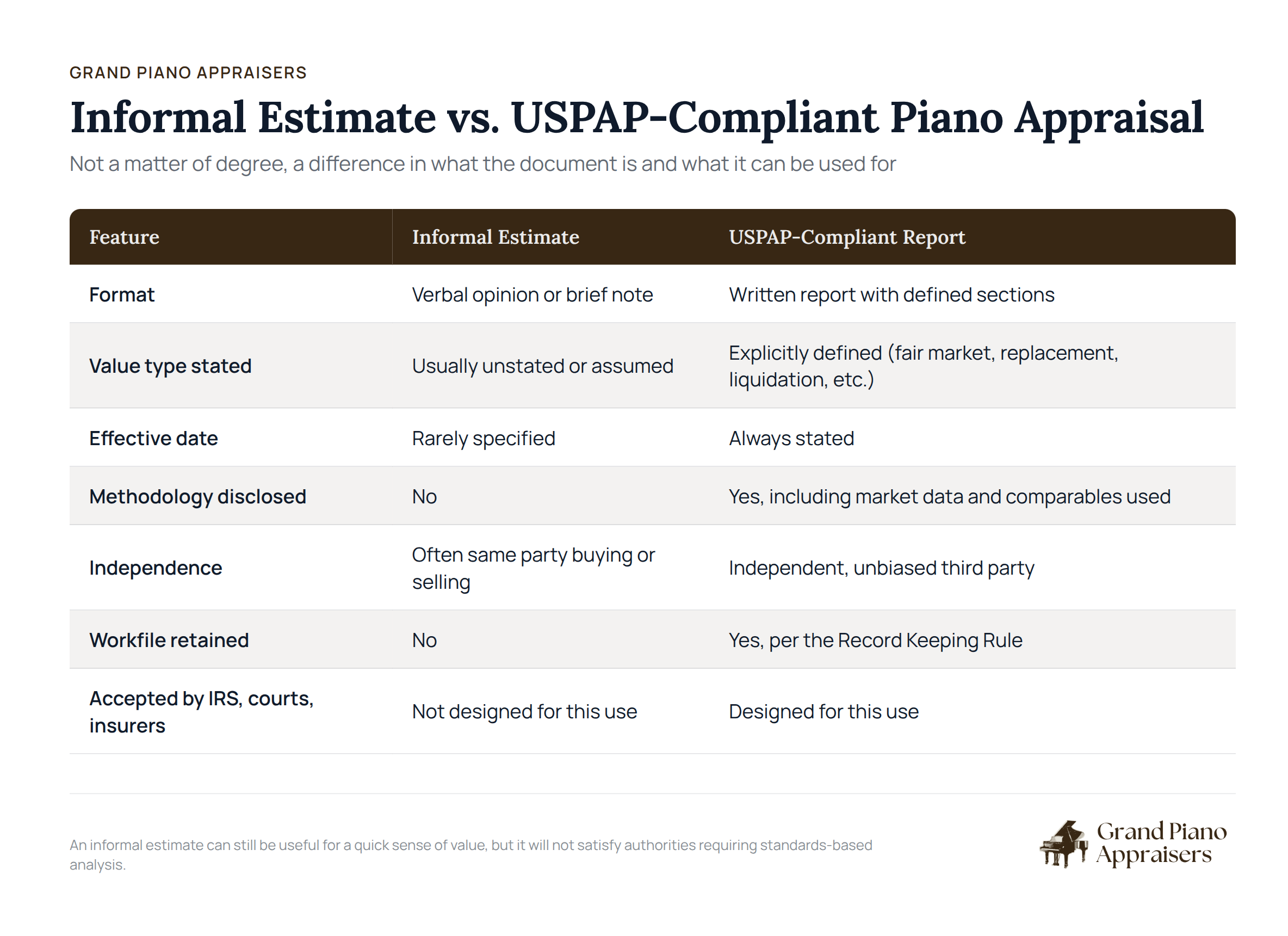
Informal Estimate vs. USPAP-Compliant Piano Appraisal Report
The difference between a verbal number from a dealer and a USPAP-compliant report is not a matter of degree. It is a difference in what document actually exists and what it can be used for.
| Feature | Informal Estimate | USPAP-Compliant Appraisal Report |
|---|---|---|
| Format | Verbal opinion or brief note | Written report with defined sections |
| Value type stated | Usually unstated or assumed | Explicitly defined (fair market, replacement, liquidation, etc.) |
| Effective date | Rarely specified | Always stated |
| Methodology disclosed | No | Yes, including market data and comparables used |
| Inspection disclosed | Not documented | Described in the report |
| Independence | Often the same party who wants to buy or sell | Independent, unbiased third party |
| Workfile retained | No | Yes, per the Record Keeping Rule |
| Signed certification | No | Yes, addressing USPAP compliance |
| Accepted by IRS, courts, insurers | Not designed for this use | Designed for this use |
An informal estimate can be genuinely useful for a quick sense of value before listing an instrument for sale. It is simply not the same product, and it will not satisfy a reviewing authority that requires documented, standards-based analysis.
Why Insurers, Courts, and the IRS Require This Level of Rigor
Each of these reviewing parties has a reason to demand more than a number on a napkin. An insurer needs a documented basis for a scheduled value so that a claim payout is defensible rather than arbitrary. A court needs a report from an independent party so that neither side in a divorce or estate dispute can accuse the other of picking a favorable figure. The IRS has the most codified requirement of the three.
For a non-cash charitable contribution, the IRS requires a qualified appraisal prepared by a qualified appraiser, and it defines a qualified appraisal as one that follows generally accepted appraisal standards, which in practice means the substance and principles of USPAP. See IRS.gov for current guidance on qualified appraisal requirements. A donor who submits a dealer's verbal valuation, or a note without a defined value type and effective date, risks having the deduction denied outright, regardless of whether the number itself was reasonable.
Key takeaway: The rigor is not bureaucratic overhead. It exists because the reviewing party (an insurer, a judge, the IRS) has to be able to trust a stranger's conclusion without independently verifying it themselves.
Piano Owners Should Know: There Is No "USPAP Certification"
One point of confusion is worth clearing up directly. Taking a USPAP course does not make an appraiser "USPAP certified," and no such credential exists in that form. The correct language is that an appraiser's work is USPAP-compliant, and that a report conforms to the USPAP standard.
An appraiser's actual credentials come from membership organizations, and members of groups like the International Society of Appraisers or the American Society of Appraisers agree to comply with USPAP as a condition of that membership. USPAP compliance describes the process, documentation, and ethics behind the report. It is not, by itself, a guarantee that every reader will agree with the concluded value, and it is not a state license. If a report or an appraiser's marketing claims a "USPAP certification," that phrasing itself is a signal to ask more questions.
Watch out: A report that states a dollar figure without stating the value type, the effective date, or the appraiser's basis for the conclusion is not a USPAP-compliant report, no matter how detailed the description of the piano sounds.
What This Means for Getting Your Piano Appraised
Because a USPAP-compliant report requires an inspection, market research, and a documented workfile, the fee reflects the depth of that work rather than the piano's dollar value. Our appraisals are quoted as a fixed fee after we scope the assignment, based on factors like the intended use, the complexity of the instrument's history, and whether the report needs to meet IRS-qualified appraisal standards. Engagements are never billed hourly.
If you are preparing for an estate, a donation, an insurance claim, or a divorce settlement, the report needs to answer to whoever reviews it next: an insurer's claims desk, a probate court, or the IRS. An informal number rarely survives that scrutiny. A request for an appraisal starts with a conversation about what the report needs to accomplish, and our appraisers scope the assignment from there.
This article is provided for general informational purposes only and does not constitute legal, tax, or financial advice. Readers should consult a qualified attorney or CPA regarding their specific circumstances.