
Blog
Piano Donation Appraisal for the IRS: What Form 8283 Actually Requires
A piano donation claimed above $5,000 requires a qualified appraisal attached to Form 8283 Section B, not just a receipt from the charity. This guide walks through the Declaration of Appraiser, the 60-day appraisal window, and what separates Section A from Section B so your deduction holds up.
When Does a Piano Donation Need an Appraisal?
A piano donation needs a qualified appraisal when the claimed deduction for the instrument, or for a group of similar items donated to one or more charities, exceeds $5,000. Below that threshold, the IRS accepts simpler substantiation. Above it, Form 8283 requires a signed appraisal summary in Section B, and the appraisal behind it has to meet specific content and timing rules.
We prepare these reports constantly for donors giving a family piano to a school, a church, or a university music program, and the paperwork trips people up more often than the valuation itself. Our piano appraisal team sees the same questions from donors every tax season: what counts as "similar property," who has to sign Part III, and whether the appraisal has to happen before or after the piano leaves the house. This guide walks through each requirement in order.
The Three Tiers of Charitable Substantiation
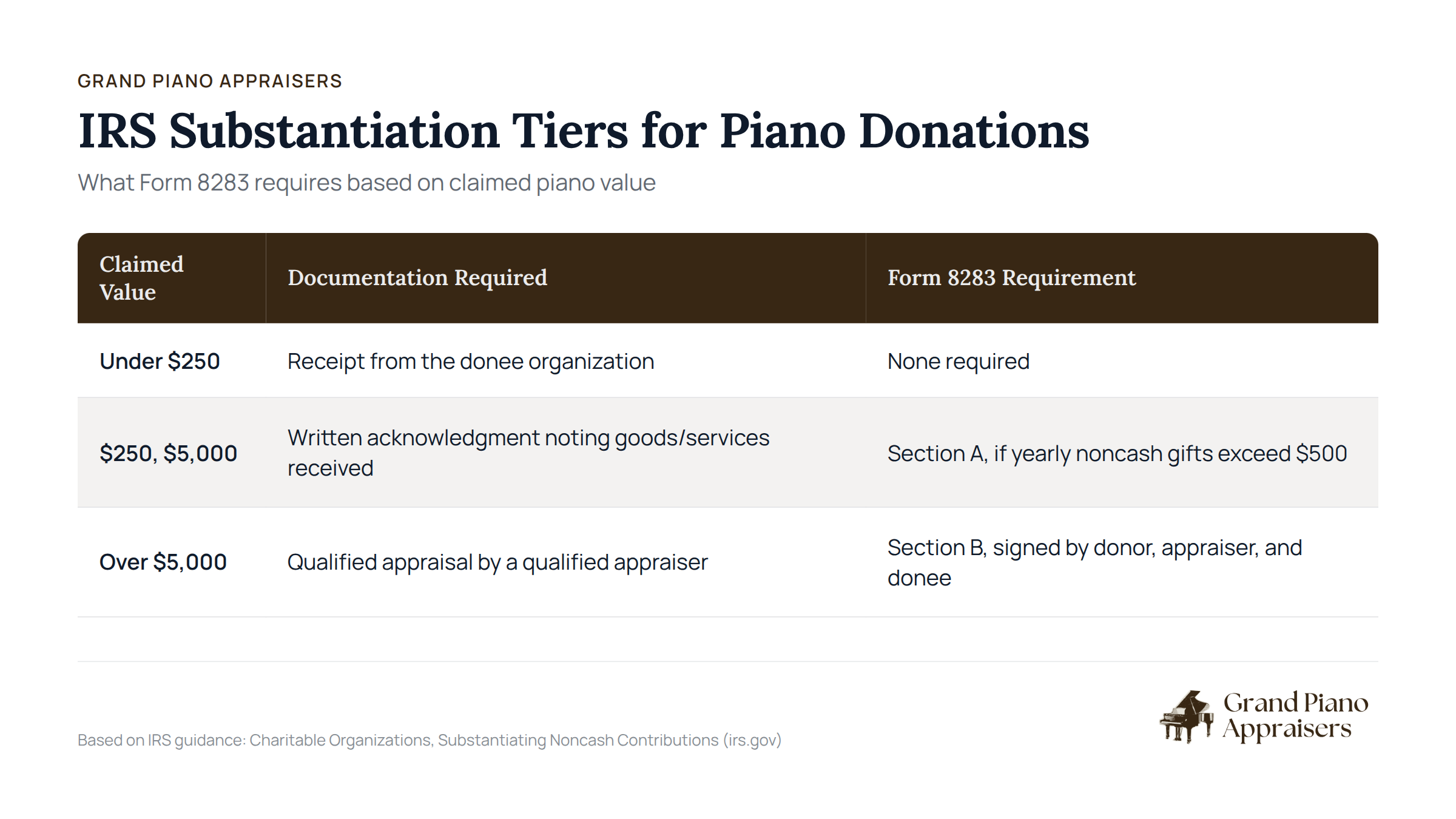
The IRS splits noncash donation substantiation into three tiers based on claimed value, and a piano can land in any of them depending on what it is worth.
- Under $250: A receipt from the donee organization is enough. No appraisal, no special form.
- $250 to $5,000: The donor needs a contemporaneous written acknowledgment from the charity describing the piano and confirming whether any goods or services were received in exchange, and Form 8283 Section A is attached once total noncash contributions for the year exceed $500.
- Over $5,000: The donor needs a qualified appraisal prepared by a qualified appraiser, and Form 8283 Section B must be completed and signed by the donor, the appraiser, and the donee, as described in the IRS guidance on substantiating noncash contributions.
Most upright pianos and many older grand pianos fall comfortably under $5,000, which means a letter from the donee and a Section A filing may be all that is required. A well-maintained Steinway, Mason & Hamlin, or Bosendorfer grand, on the other hand, routinely clears that threshold on its own.
The $5,000 Threshold and the Aggregation Rule
The $5,000 figure is not just about the piano by itself. The qualified appraisal requirement applies once the claimed value of an item, combined with similar items given to the same or different donees in the same tax year, exceeds $5,000. A piano donated with a matching bench, a set of vintage sheet music, or a second instrument given to a different school in the same year can push the combined claim over the line even if no single piece would qualify alone.
Example: A donor gives a 1970s console piano valued at $1,800 to one charity and a separate upright valued at $3,600 to another charity in the same calendar year. Individually, neither crosses $5,000. Because pianos are treated as similar property, the combined claimed value of $5,400 triggers the qualified appraisal requirement for both.
The instructions for Form 8283 direct donors to attach a separate Form 8283 for each donee once the aggregate claim crosses $5,000, with a separate qualified appraisal supporting each item or group of similar items. This is the detail that catches people giving instruments to more than one organization in a single year.
Form 8283: Section A vs Section B
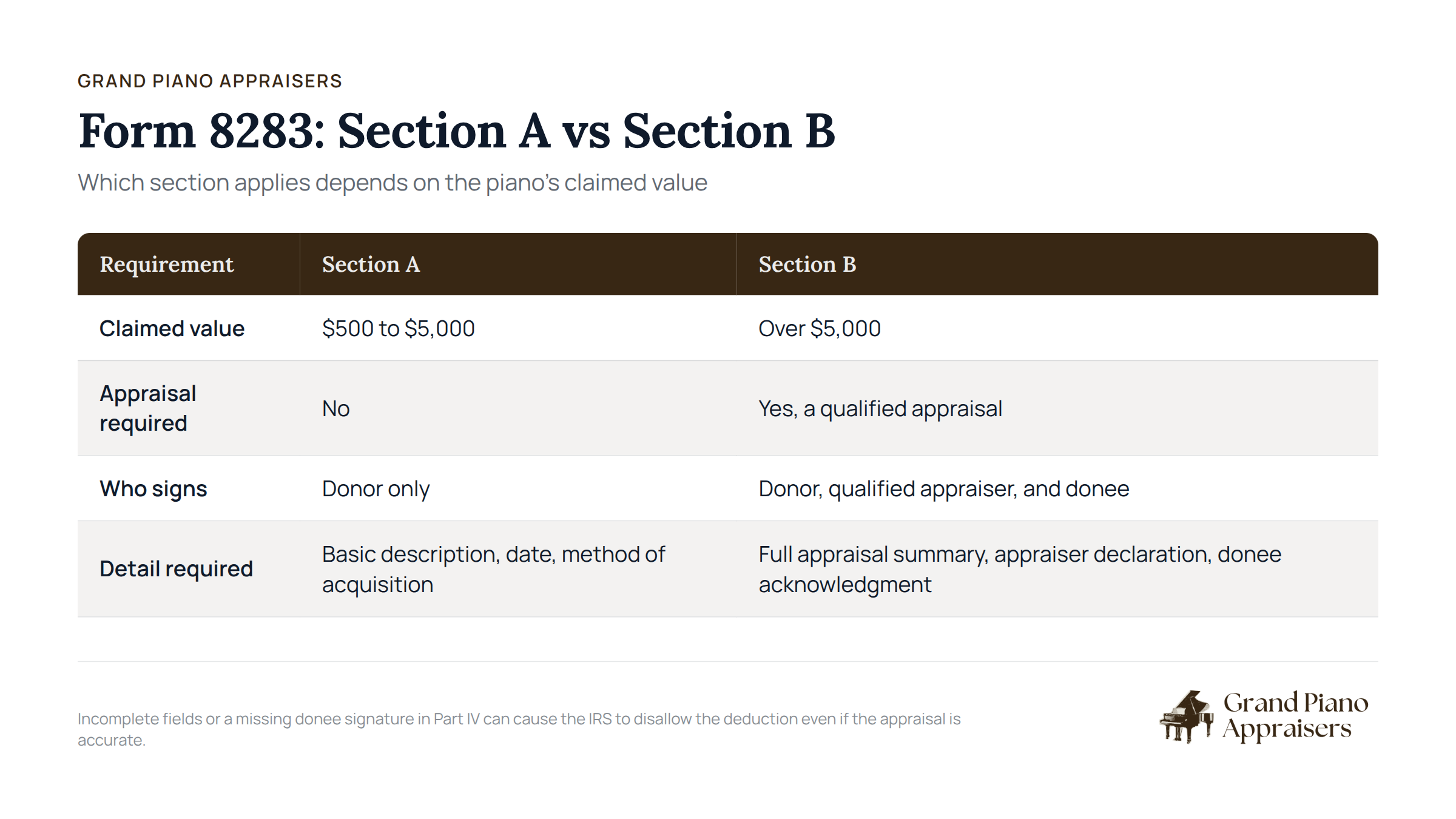
Form 8283 has two sections, and which one applies depends entirely on the claimed value of the piano, not on the type of charity receiving it or how the donor feels about the instrument's worth.
| Section A | Section B | |
|---|---|---|
| Claimed value | $500 to $5,000 | Over $5,000 |
| Appraisal required | No | Yes, a qualified appraisal |
| Who signs | Donor only | Donor, qualified appraiser, and donee |
| Detail required | Basic description, date, method of acquisition | Full appraisal summary, appraiser declaration, donee acknowledgment |
Section B is where most of the compliance risk lives. It asks for a description of the piano specific enough to identify it (make, model, serial number, condition), the appraised fair market value, the valuation method used, and the date of both the appraisal and the contribution. Leaving any of these fields incomplete, or skipping the donee's signature in Part IV, can cause the IRS to disallow the deduction even when the appraised value itself is accurate.
The Declaration of Appraiser in Part III
Part III of Section B, the Declaration of Appraiser, is a sworn statement the appraiser signs confirming several things: that they hold themselves out to the public as an appraiser, that they understand a false or fraudulent overstatement of value can lead to civil penalties, and that they are not the donor, the donee, a party to the transaction, or someone otherwise disqualified under the qualified appraiser rules.
One detail trips up donors who shop for the cheapest appraisal they can find: the appraiser's fee cannot be based on a percentage of the appraised value. A percentage-based fee arrangement disqualifies the appraisal outright, regardless of how accurate the number turns out to be. Every engagement we take on for a charitable donation is quoted as a fixed fee before work begins, scoped around the piano's complexity and the documentation available, never billed as a cut of the final value.
The appraiser also has to provide their taxpayer identification number on the form. This is a real signature and a real professional on the hook, not a formality, which is why the IRS treats an unsigned or improperly completed Part III as grounds to reject the deduction.
Timing Rules: the 60-Day Window and the Return Due Date
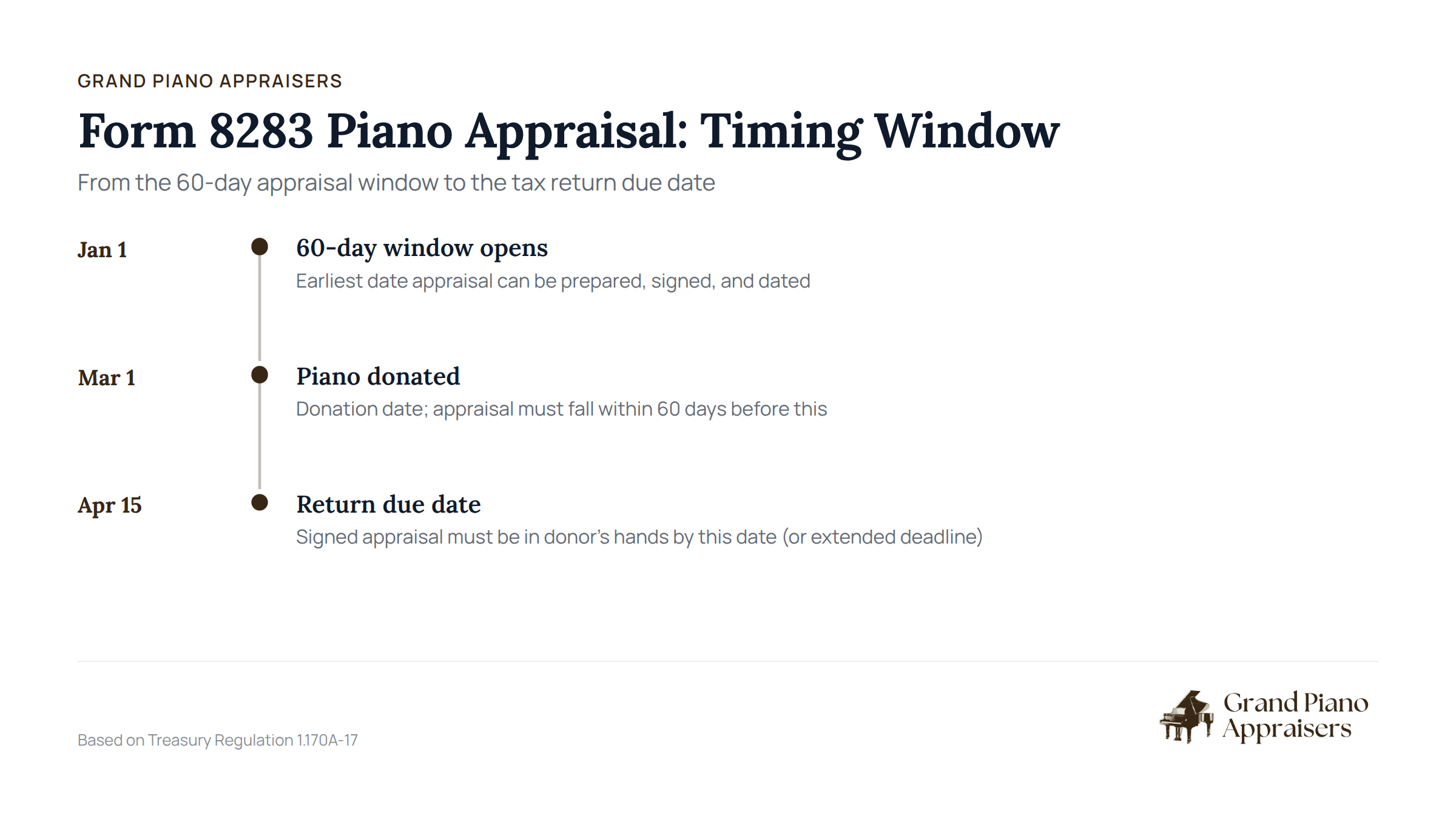
The appraisal has to be dated close to the actual donation, and it has to reach the donor before taxes are filed. Under Treasury Regulation 1.170A-17, the appraisal must be prepared, signed, and dated no earlier than 60 days before the date the piano is actually donated. It also has to be received by the donor no later than the due date, including extensions, of the tax return on which the deduction is first claimed.
- Too early: An appraisal completed more than 60 days before the piano leaves the donor's home does not satisfy the timing rule, even if the valuation is still accurate.
- Too late: An appraisal obtained after the return is filed, or after an extended due date has passed, cannot support a deduction already claimed on that return.
- On time: An appraisal dated within the 60-day window before donation, and in hand before the filing deadline, meets the standard.
Example: A donor plans to give a grand piano to a university on March 1. An appraisal dated any time from January 1 through March 1 falls inside the 60-day window. If the donor files an on-time return without an extension on April 15, the signed appraisal needs to be in hand well before that date so Section B can be completed accurately.
Why a USPAP-Compliant Piano Appraisal Matters
The regulation defines a qualified appraisal as one prepared by a qualified appraiser in accordance with generally accepted appraisal standards. For personal property, that standard is USPAP (the Uniform Standards of Professional Appraisal Practice), and credentialed piano appraisers typically hold training through organizations such as the ISA, ASA, AAA, or CAGA.
A generic retail quote, a dealer's trade-in estimate, or an insurance replacement figure is not a substitute. Those numbers answer a different question than the one the IRS is asking. A qualified appraisal has to identify the piano's make, model, serial number, age, condition, and any restoration history, then explain the valuation method and the market evidence behind the concluded fair market value, not just state a dollar figure. We cover what belongs in that report, section by section, in our guide to what a USPAP-compliant piano appraisal report actually includes.
Because piano donation appraisals vary so much in complexity (a plain upright is a very different assignment than a restored 9-foot concert grand with a known performance history), our fee is quoted as a fixed amount once we understand the instrument and the intended use of the report, never estimated off the piano's market value.
Example: Donating a Steinway Grand to a University Music Program
Consider a donor giving a Steinway Model D concert grand, built in the 1960s and well maintained, to a university music department. A dealer suggests the piano could retail for $45,000, but the donor's appraiser determines a fair market value of $18,000 based on comparable sales of similar age, condition, and rebuild history.
Because the claimed value exceeds $5,000, the donor needs:
- A qualified appraisal dated within 60 days of the donation, prepared by an appraiser with no percentage-based fee arrangement and no disqualifying relationship to the donor or the university.
- A completed Form 8283, Section B, with the piano's description, appraised value, and valuation method, signed by the donor in Part I and the appraiser in Part III.
- The university's signature in Part IV acknowledging receipt of the instrument, confirming it accepted the piano and describing any intended use.
- The appraisal received before the donor's tax return due date, including any extension, for the year the piano was given.
If the donor also gives a matching artist bench and a set of rare scores to the same department in the same year, those items get folded into the same similar-property analysis rather than treated as separate small donations.
Getting any one of these pieces wrong, a missing signature, a late appraisal date, or a fee tied to the final number, can put the entire deduction at risk even when the underlying valuation is sound. If you are planning a piano donation and need a USPAP-compliant appraisal that stands up to IRS review, our team can start your piano donation appraisal and walk you through exactly what Form 8283 will require for your situation.
This article is provided for general informational purposes only and does not constitute legal, tax, or financial advice. Readers should consult a qualified attorney or CPA regarding their specific circumstances.