
Blog
Grand Piano Appraisal vs Upright: How the Approach Actually Differs
A grand piano appraisal and an upright appraisal both follow USPAP, but they pull different comparables, inspect different components, and weigh brand premiums differently. This guide walks through exactly where the two approaches diverge and why that changes your reported value.
Owners often assume a piano appraisal is a piano appraisal: someone measures the instrument, checks the serial number, and names a number. In practice, a grand and an upright are different valuation problems wearing the same instrument name. The size categories, the internal construction, the pool of buyers who actually want each type, and even the way a brand name moves the price all diverge once you get past the keyboard.
Whether you're appraising a grand piano for an estate, an insurance claim, or a charitable donation, understanding these differences helps you read your report with more confidence and ask better questions when you're scoping the assignment.
Why Size and Construction Change the Appraisal, Not Just the Instrument
A grand piano appraisal and an upright appraisal rest on the same foundation: identify the instrument precisely, inspect its condition, select appropriate comparables, and apply the valuation approach that best fits the assignment's intended use. USPAP requires an appraiser to consider the recognized approaches to value and explain why any are excluded, and that discipline applies equally to a 9-foot concert grand and a 40-inch console.
What changes is the data underneath that framework. A grand's horizontal case, larger soundboard, and longer string scale create different condition risks and a different buyer pool than a vertical upright. Those physical and market realities drive almost every practical difference described below.
Size Categories Inside Each Type Drive Comparable Selection
Grands and uprights each split into sub-categories, and an appraiser treats those sub-categories as separate markets, not interchangeable variations on a theme.
Grand pianos are generally grouped as follows:
- Baby grand: roughly 5'0" to 5'5" in length, the most common size in private homes.
- Parlor or living room grand: roughly 5'6" to 6'3", a step up in projection and tone.
- Concert grand: 7 feet to 9 feet or longer, built for performance halls and institutional use.
Upright pianos split along cabinet height instead of length:
- Spinet: roughly 36 to 40 inches tall, the smallest and least common in today's used market.
- Console: roughly 40 to 43 inches, the most typical size for home ownership.
- Studio: roughly 45 to 48 inches, often preferred by teachers and serious students for improved tone and action response.
A baby grand sale tells an appraiser almost nothing about a concert grand's value, and a console comparable is a poor stand-in for a studio upright. Pulling comparables from the correct sub-category is one of the first places a grand and an upright appraisal genuinely part ways.
Horizontal vs Vertical Construction Changes What the Appraiser Inspects
A grand's soundboard sits beneath horizontal strings running at a diagonal for a longer bass scale, while an upright's soundboard stands vertically behind a shorter, more compact string layout. That single difference in geometry changes where condition problems show up and how an appraiser documents them.
For a grand, the appraiser typically examines the underside of the case, the rim, the plate, the bridges, the action (which relies on gravity and a repetition lever for its characteristic touch), and the pedal and lid hardware. For an upright, inspection focuses on the action's spring-driven mechanism, the pinblock and back posts, the cabinet structure, and the veneer or finish, since the cabinet itself carries more of the instrument's furniture value in the upright market.
Watch out: A grand with a replaced soundboard or restrung bass section can look cosmetically pristine while carrying a materially different value than an all-original example. The appraiser needs documentation of what was replaced, by whom, and when, not just a visual once-over.
Condition findings on an upright are usually dominated by practical questions: does the action respond evenly, is the cabinet finish intact, and is the instrument in tune-stable condition. Condition findings on a grand more often hinge on originality, the quality of any rebuilding, and whether key components still perform to the standard the model was built for.
Market Appeal and Liquidity Differ Sharply Between the Two
Grand pianos, particularly from prestige makers, draw interest from collectors, conservatories, performance venues, and serious players willing to pay for scale, tone, and provenance. That demand supports a thinner but often higher-value market, where a well-documented rebuild can meaningfully increase price.
Uprights trade in a far more practical pool. Buyers are usually space-constrained homeowners, students, or teachers looking for a functional instrument at a modest price, and the used upright market is often saturated with inexpensive or even free listings. This liquidity gap matters for the appraiser: a grand appraisal can lean on a smaller number of carefully matched comparables because the market for that model and length is narrower but more defined, while an upright appraisal usually has more transaction data available but needs to filter out non-comparable giveaways and distressed sales that don't reflect true market value.
How the Comparable-Sales and Cost Approaches Apply Differently
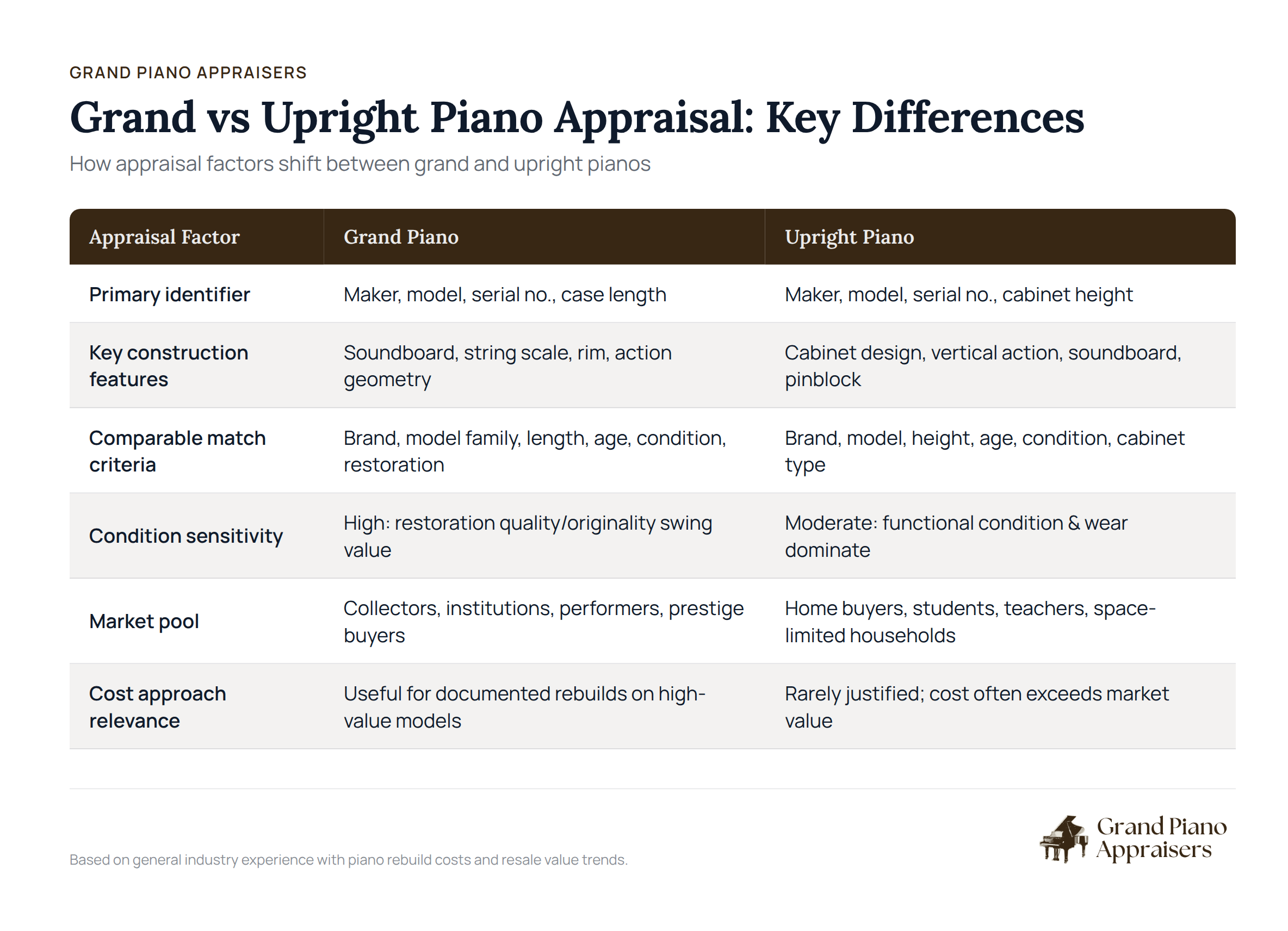
The sales comparison approach is typically the most relevant method for privately owned pianos of either type, but the inputs look different once you compare a grand to an upright side by side.
| Appraisal Factor | Grand Piano | Upright Piano |
|---|---|---|
| Primary identifier | Maker, model, serial number, case length | Maker, model, serial number, cabinet height |
| Key construction features | Soundboard area, string scale, rim, action geometry, pedal configuration | Cabinet design, vertical action, soundboard, pinblock, pedal configuration |
| Comparable match criteria | Brand, model family, length, age, condition, restoration status | Brand, model, height, age, condition, cabinet type |
| Condition sensitivity | High: restoration quality and originality can swing value significantly | Moderate: functional condition and cabinet wear typically dominate |
| Market pool | Collectors, institutions, performers, prestige-brand buyers | Practical home buyers, students, teachers, space-constrained households |
| Cost approach relevance | Useful for documented rebuilds on high-value models | Rarely justified; cost often exceeds achievable market value |
The cost approach illustrates the split well. On a concert or prestige-brand grand, a documented, professionally executed rebuild (new soundboard, restrung scale, rebuilt action) can be reflected in value because the market for that model actually rewards the investment. General industry experience shows rebuild work on high-end grands can run into five figures, and when the market supports it, that cost is recoverable in resale or appraised value.
For most uprights, the math works against the cost approach. A full rebuild can easily exceed what a console or studio upright would sell for afterward, so an appraiser will usually note the cost approach as considered but not applicable, relying instead on comparable sales in the practical buyer market. This is also why fees for piano appraisals are quoted as a fixed amount after we scope the specific instrument, since the depth of research and comparable analysis for a rebuilt prestige grand is simply a larger assignment than a standard console upright.
Brand and Model Family Premiums Shift by Piano Type
Brand reputation carries weight in both markets, but not the same weight. A Steinway grand commands a premium tied to scale design, soundboard engineering, and resale demand among serious players and institutions, and that premium widens with length and with well-documented rebuilding by a recognized shop. A Yamaha or Kawai grand holds strong, more consistent value in the mid-market and institutional segment, often favored for its reliability and lower restoration risk.
In the upright category, the same brand names behave differently. A Yamaha or Kawai console or studio upright is prized for dependable touch and tone at a practical price point, but it does not carry anything close to the collector premium its grand counterpart might earn. A vintage Steinway upright can still outperform a generic upright of the same age, but the gap between "good brand" and "prestige brand" compresses sharply once you move from horizontal to vertical construction, simply because the buyer pool for uprights is not shopping for prestige in the first place.
A Worked Example: Baby Grand vs Console Upright
Example: Consider two pianos coming into the same estate: a 5'1" baby grand from a well-regarded maker, built 35 years ago and never rebuilt, and a 42-inch console upright from a mainstream Japanese maker, built 20 years ago and recently tuned.
For the baby grand, the appraiser pulls comparables matched by length (5'0" to 5'5"), brand, and age, then adjusts for condition: original soundboard and action, moderate wear consistent with regular home use, no structural issues. Because this length and brand combination has an active resale market among serious home players and some institutional buyers, recent comparable sales carry strong weight, and the cost approach is noted but excluded since no rebuild work has been performed.
For the console upright, the appraiser pulls comparables matched by height, brand, and age within the practical home-buyer market. Condition findings focus on action responsiveness, cabinet finish, and tuning stability rather than originality of internal components. Because consoles in this age and condition range are common and often priced to move quickly, the appraiser filters out distressed or giveaway listings to isolate genuine arm's-length transactions before concluding value.
The same USPAP-grounded process produced two very different reports: one weighted toward a narrower, prestige-sensitive market, the other weighted toward a broader but lower-value practical market. Neither approach is more rigorous than the other; they're simply calibrated to the instrument and the market it actually competes in.
What This Means for Your Appraisal Report
If your piano is headed for a charitable donation, the IRS requires a qualified appraisal for any single item claimed above $5,000, and that appraisal must describe the property, its condition, and the method used to reach fair market value, consistent with the IRS Instructions for Form 8283. For gifts above $500,000, the appraisal generally must be attached to the return, per IRS Topic No. 506. These thresholds apply the same way to a grand and an upright; what differs is the comparable data and condition analysis an appraiser needs to support the stated value, as outlined in IRS Publication 561.
For an insurance claim or an estate filing, the intended use controls the definition of value just as much as the piano type does. A rebuilt grand's insurance replacement value is not its resale value, and a dealer's asking price for a console is not a completed sale. Knowing whether your instrument is a baby grand or a console, and understanding which market it actually competes in, helps you read a USPAP-compliant report with the right expectations. If you're weighing whether your own piano's value supports a formal appraisal, our guide on what a fair price for a used piano actually looks like is a useful next read, along with our breakdown of what a USPAP-compliant piano appraisal report includes.
Grand and upright pianos will keep getting lumped together as "pianos" in casual conversation, but a defensible appraisal treats them as the distinct markets they are. If you need a grand piano appraised for an estate, insurance policy, or donation, our team can scope the assignment and quote a fixed fee based on the instrument's size, condition, and intended use.
This article is provided for general informational purposes only and does not constitute legal, tax, or financial advice. Readers should consult a qualified attorney or CPA regarding their specific circumstances.